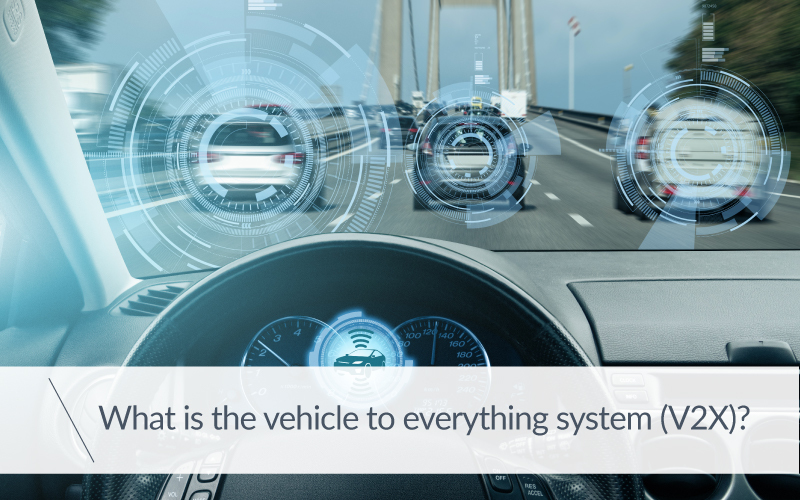
The vehicle-to-everything (V2X) system represents one of the most significant innovations in the connected mobility scenario. It is an advanced communication system that allows vehicles to interact in real-time with their surroundings, exchanging data with other vehicles, infrastructures, pedestrians, electricity grids, and smart buildings.
This network of connections expands the vehicle's perceptive capabilities beyond its on-board sensors, creating an extended information ecosystem that integrates safety, efficiency, and sustainability.
V2X thus becomes a fundamental pillar of smart mobility, where every interaction contributes to safer and more coordinated traffic flow.
Different forms of communication
The V2X system comprises various communication modes, each designed to meet specific needs concerning safety, efficiency, and interaction with the environment.
Vehicle-to-Vehicle (V2V) communication enables vehicles to exchange real-time data on traffic, speed, and position, thereby reducing the risk of collisions and enhancing traffic flow.
Vehicle-to-Infrastructure (V2I) connectivity, on the other hand, enables the vehicle to communicate with road and urban systems - such as traffic lights, signage, or traffic control centres - optimising routes and contributing to more efficient mobility management.
An equally important role is played by Vehicle-to-Pedestrian (V2P) communication, which makes it possible to identify potentially dangerous situations for pedestrians and cyclists, thus increasing safety in the busiest urban areas.
Finally, Vehicle-to-Grid (V2G) and Vehicle-to-Home (V2H) applications extend the principle of connectivity to the energy sector, transforming electric vehicles into active units of the grid: capable of returning energy to the electrical system or supporting the smart management of domestic energy consumption.
The Technology underpinning V2X
This ecosystem is underpinned by two main families of technologies.
The first includes dedicated short-range communication (DSRC) systems, used for direct, localised exchanges, which are essential for highly reactive communications. The second is based on new-generation cellular networks (C-V2X / 5G), which guarantee wide coverage, low latency, and greater transmission capacity.
The combination of the two allows for simultaneous, stable, and secure data transmission - an indispensable condition for the most critical applications, such as assisted or autonomous driving, and for dynamic urban traffic management.
Market Growth and Key Industry Players
According to an analysis published by GlobeNewswire, the global V2X market is expanding rapidly, with growth forecast to reach $155.17 billion by 2030, registering a Compound Annual Growth Rate (CAGR) of 42.2% between 2025 and 2030.
This growth is driven by the rise of smart vehicles, the evolution of on-board electronic systems, and an increasing demand for connectivity services. The sector is being led by major companies committed to developing advanced solutions that support the industrial rollout of V2X and its integration into new-generation automotive models.
Benefits and potential
The adoption of V2X brings tangible benefits both for road safety and for sustainability.
Access to real-time data allows for the anticipation and prevention of risk situations, improving traffic management and reducing accidents and congestion. At the same time, integration with the power grid via V2G and V2H supports smart energy management, reducing peak demand and optimising resource use.
Looking ahead, V2X has the potential to transform the vehicle into an energy and information platform, capable of communicating with its surroundings and contributing to the stability of complex systems.
Challenges and development perspectives
However, the widespread adoption of V2X requires shared standards, secure protocols, and adequate infrastructure.
Data protection, communication synchronisation, and compatibility between vehicles and networks are essential conditions to ensure the system's reliability.
Despite these challenges, the sector demonstrates a clear and dynamic way forward: the combination of technological innovation and global investments is laying the groundwork for more interconnected, automated, and sustainable mobility.
Towards a new mobility paradigm
V2X is more than just a technology: it is a new architecture for mobility, where vehicles, infrastructure, and energy grids move in synergy.
Its evolution marks a decisive shift towards an intelligent transport ecosystem, capable of adapting to the context in real time and responding to demands for efficiency and safety.
In this scenario, every vehicle becomes part of a shared system, where data points help make mobility safer, smoother, and more sustainable. It is a step forward toward a future where connectivity is not just digital, but also energetic, collaborative, and conscious.