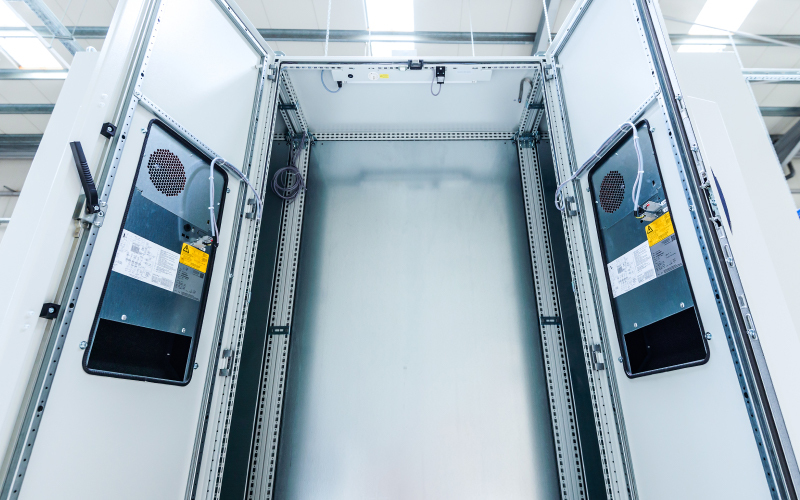
For decades, industrial enclosures were treated as secondary elements within complex systems. Once the core engineering work was completed - electronics, software, power conversion - the enclosure was specified late in the development process, often selected primarily on cost considerations.
This approach no longer reflects today’s industrial reality. In sectors such as EV charging infrastructure, energy storage, industrial automation and high-power electronics, enclosures have become strategic components. Their design and industrialization now influence not only cost, but also system performance, safety, certification timelines, long-term reliability and the ability to scale production. In many cases, the enclosure makes the difference between a product that reaches market maturity smoothly and one that struggles under the weight of late-stage redesigns and operational constraints.
System complexity, and the enclosure as part of the functional architecture
Industrial systems are becoming more powerful, more integrated and more constrained by regulatory and operational requirements. Applications such as ultra-fast EV chargers, grid-connected energy systems and advanced electromechanical equipment must operate at high voltages and currents, manage increasing power density and withstand significant thermal stress, while simultaneously meeting EMC, electrical safety and environmental protection standards.
In this context, the enclosure can no longer be considered a passive boundary. It becomes a functional element of the system architecture, directly interacting with electronics, cooling circuits, cabling and safety components. Mechanical design decisions influence electrical behaviour, thermal efficiency and long-term reliability, making enclosure engineering inseparable from system-level design.
Modern enclosures are required to fulfil multiple roles at once. They must provide structural support for heavy power modules and magnetics, enable controlled airflow or liquid-cooling paths, support EMC shielding and grounding strategies, guarantee electrical segregation and safety clearances, and protect sensitive components from harsh indoor or outdoor environments. At the same time, they must allow safe, efficient access for maintenance throughout the system’s lifecycle.
As integration increases, even minor mechanical choices - such as sheet-metal geometry, fastening concepts, tolerances or surface treatments - can have measurable effects on thermal performance, EMC behaviour, corrosion resistance and serviceability. These effects often only become visible during validation or certification, when design changes are costly and timelines are already under pressure.
For this reason, enclosure design can no longer be treated as a downstream activity. It must be addressed as part of the functional architecture from the earliest development stages, alongside electrical, thermal and system engineering. Only through this integrated approach can complex industrial products achieve the performance, safety and scalability required to succeed in today’s markets.
The hidden cost of late or cost-driven decisions
One of the most common mistakes in industrial programs is postponing enclosure industrialization until late in development, or selecting suppliers purely based on unit price. The consequences typically emerge when time pressure is highest: certification delays due to EMC or safety issues, thermal rework caused by underestimated heat dissipation, production inefficiencies linked to poor assemblability, quality issues driven by uncontrolled tolerances, and logistics risks stemming from long or inflexible supply chains.
What initially appears as a cost saving often becomes a cost multiplier. In regulated industrial markets, lost time-to-market frequently outweighs any theoretical savings on the enclosure itself.
From prototype to series: where many projects struggle
Another critical challenge lies in the transition from prototype to serial production. Enclosures that perform adequately in pilot builds often reveal weaknesses when volumes increase. Excessive manual operations, tight tolerances that are difficult to maintain consistently, designs dependent on craftsmanship rather than industrial processes, and assembly sequences not optimized for takt time or ergonomics, all limit scalability.
True industrialization requires enclosure designs that are robust, repeatable and tolerant to variation, while still meeting demanding technical requirements. This is where early involvement of manufacturing expertise becomes essential. Experienced industrial partners can identify risks long before they appear on the production line.
Manufacturing know-how as a strategic capability
Producing complex industrial enclosures at scale requires far more than fabrication capacity. It demands deep knowledge of materials, forming processes, welding technologies and structural assembly. It requires surface treatments designed for outdoor and industrial environments, process engineering for repeatability and consistent quality, and the ability to integrate mechanical assemblies with electrical and thermal systems - all supported by quality systems aligned with industrial and automotive standards.
When these capabilities are embedded early in a project, the enclosure becomes a stabilizing element rather than a source of uncertainty.
Why European manufacturing is regaining strategic importance
In recent years, many industrial companies have reassessed global sourcing strategies. While cost remains important, it is no longer the only driver. For system-defining components such as industrial enclosures - especially those integrated with high-power electronics - European manufacturing offers clear advantages: proximity to engineering teams, shorter and more predictable lead times, alignment with regulatory and certification requirements, higher transparency and reduced exposure to geopolitical and logistics disruptions.
This does not imply abandoning global supply chains, but rather adopting a more selective approach, placing critical components where reliability and responsiveness matter most.
Enclosures in EV charging and energy infrastructure
The evolution of EV charging infrastructure clearly illustrates why enclosure strategy has become critical. Ultra-fast chargers operate at very high power levels, often outdoors, and must combine electrical safety, EMC compliance, effective thermal management, mechanical robustness against environmental exposure and vandalism, and high serviceability to ensure uptime.
In these systems, enclosure design is inseparable from overall system performance. Poor mechanical integration can limit power output, increase failure rates or complicate maintenance. As charging networks scale, industrialization becomes the true differentiator.
The FAIST industrial perspective
At FAIST Industrial, enclosures are approached as industrial systems, not isolated metal components. The focus is on enabling customers to industrialize complex products with confidence, through long-standing experience in industrial and electromechanical manufacturing, scalable European production sites, robust processes suitable for demanding environments, and close collaboration with customer engineering teams to ensure manufacturability.
FAIST Industrial does not design customer products nor claim their intellectual property. Instead, it contributes manufacturing expertise that helps transform designs into reliable, scalable industrial solutions.
Enclosures as a competitive differentiator
As industrial systems continue to evolve, enclosures will play an even more strategic role. Increasing power density, tighter regulations and higher customer expectations leave little margin for error.
Companies that treat enclosures as commodities risk delays, redesigns and inefficiencies. Those that integrate enclosure strategy into product development gain faster time-to-market, higher reliability, better scalability and stronger long-term competitiveness.
In today’s industrial landscape, enclosures are no longer “just metal”. They are a strategic component - one that directly shapes the success of the entire system.