The rapid expansion of data centres, AI-driven computing infrastructure, advanced cooling systems and new power-generation architectures is increasing demand for industrial components capable of operating in increasingly demanding environments.
Behind these systems lies a manufacturing ecosystem that is becoming more sophisticated in terms of materials and thermal management requirements, process stability and integration between mechanical and functional requirements.
In this context, some manufacturing competences historically associated with the automotive sector are finding new relevance in power-generation and energy-related applications. This is particularly true for components that must combine non-standard geometries, high-temperature resistance, tight dimensional tolerances and controlled joining processes within systems where thermal and mechanical stresses are becoming increasingly significant.
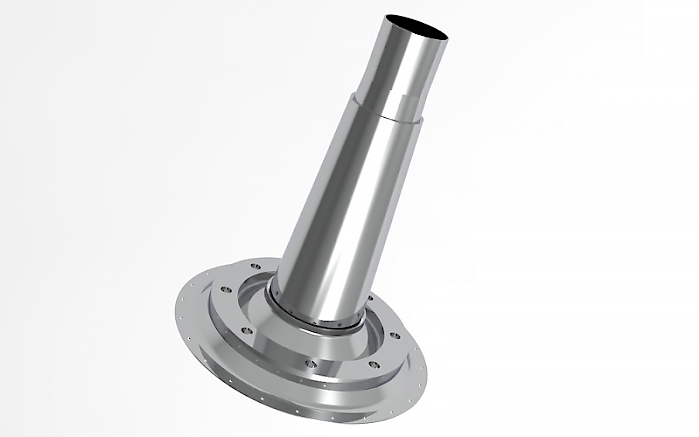
FAIST Control Systems is contributing to this through the development and production of custom tubular components manufactured from high-performance materials such as Inconel and AISI 309.
These components are produced through sheet metal rolling and laser welding processes, with leak testing performed on 100% of the parts. The contribution, however, goes beyond manufacturing. FAIST also supports the definition of components that are not only technically compliant with the final application, but also producible, controllable and repeatable from an industrial perspective.
This aspect is becoming increasingly important in advanced industrial systems. In many cases, the challenge is no longer simply designing a functional component, but ensuring that the same component can maintain dimensional consistency, welding quality and process stability across industrial volumes and over long operating cycles. The transition from prototype to repeatable production is often where apparently secondary details - geometries, weld accessibility, deformation control, clamping strategy or material behaviour during forming - become decisive.
The components involved in these projects are not standard tubes adapted to an application afterwards, but geometries developed around specific functional and integration requirements. Dimensions, thicknesses, interfaces and construction details are defined according to the operating environment and the characteristics of the system in which the component will be integrated.
This requires close interaction between design and manufacturing from the early development stages, particularly when working with nickel-based alloys and high-temperature stainless steels that require controlled forming and welding conditions.
In this type of application, rolling is not simply a shaping operation. Material springback, dimensional stability and edge preparation directly influence the subsequent welding phase and the final behaviour of the component.
The same applies to laser welding, where process control becomes essential not only for joint quality, but also for dimensional repeatability and leak-tightness. Heat input, clamping strategy, positioning systems and deformation management must operate within a stable and controlled production environment, especially when geometries are non-standard and tolerances are narrow.
Leak testing performed on all components represents another important element of this approach. In applications linked to power-generation systems and advanced industrial infrastructures, leak-tightness is not simply a quality characteristic but part of the functional validation of the component itself.
This is particularly relevant when the component operates within thermal-management or fluid-handling systems where operational continuity depends on long-term stability and controlled performance.
The experience developed in automotive and other highly demanding sectors such as aerospace manufacturing provides an important foundation for these applications. These industries have historically required high levels of process discipline, repeatability, traceability and industrial control, particularly when dealing with complex geometries, welded assemblies and scaled production environments. The competences developed in these contexts are increasingly transferable to new industrial sectors where production volumes, technical requirements and process expectations are converging toward similar levels of complexity.
As energy systems continue to evolve, the distinction between component manufacturing and industrial engineering is becoming progressively less defined. In many advanced applications, the value of a component increasingly depends on the ability to combine design support, material expertise, process stability and repeatable industrial execution within a single manufacturing approach.
This is where manufacturing know-how developed by FAIST Control Systems in highly demanding sectors can become relevant well beyond its original application field: less because of the component itself than because the ability to industrialize it reliably under complex technical conditions is becoming increasingly strategic across multiple industries.