When mechanical expertise meets advanced engineering: building better industrial systems through integration
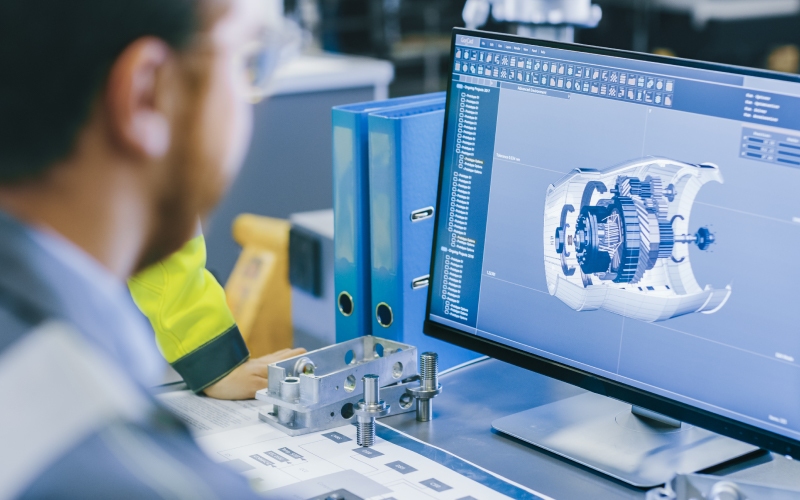
In every industrial sector, products are becoming more complex. Systems that once relied mainly on solid mechanical design now incorporate sensors, drives, automation, thermal constraints, structural behaviors and demanding reliability requirements. As technologies converge, the traditional separation between mechanical engineering and system engineering is disappearing. Today, the real value is created where these disciplines meet.
For decades, FAIST has built its strength on mechanical excellence - precision metal components, robust assemblies, and scalable industrial manufacturing. This foundation remains essential, but the needs of modern industry have evolved. Mechanical parts no longer operate in isolation: they interact with moving elements, respond to dynamic loads, support thermal paths, influence vibration behaviors and often determine whether an entire machine performs as intended. Designing a mechanical structure today requires understanding the broader system it belongs to.
The same applies to engineering. Even the most refined system architecture can struggle if the mechanical backbone behind it is not conceived with the full picture in mind. A motion system can lose accuracy if the structure is not rigid enough. A control strategy can fail if tolerances do not match real-world conditions. A well-designed component can underperform if assembly and maintenance are not considered early. Performance increasingly depends not on individual subsystems, but on how well they are integrated from the start.
This is the direction FAIST has firmly moved into: toward a model in which mechanical know-how and multidisciplinary engineering work as a single development process. Our teams design structures while thinking about how they will be driven, controlled and validated. We approach system engineering with an understanding of how real materials behave, how assemblies deform, how manufacturing choices influence performance and how products must be tested to guarantee reliability over time. Instead of treating the mechanical part and the engineered part as two separate phases, we blend them into one coherent flow that runs from concept to industrialization.
This integrated approach has a very practical impact. Development cycles become shorter as we identify issues earlier and solve them before they cascade into redesigns. Products become more reliable because we validate them as complete systems rather than as isolated components. Manufacturing becomes more efficient when design decisions already factor in assembly, tooling, and life-cycle costs from the outset. Customers gain certainty by partnering with a company that owns the full journey - from design intent to real-world performance.
What truly makes the difference is perspective. FAIST understands how a product must be designed, how it must be built and how it must be verified to perform consistently in the environments where it will actually operate. This mindset is increasingly rare in an industrial world where specialization is the norm and integration is often left to the customer to resolve. By bringing mechanical heritage and advanced engineering under one roof, we remove that gap and ensure that the system as a whole works exactly as intended.
As industries evolve towards more compact, more intelligent and increasingly interconnected systems, the ability to combine disciplines effectively becomes a true differentiator. This is exactly where FAIST stands today.
FAIST brings together high-quality mechanical expertise and advanced engineering capabilities to act as an integrator, translating complex requirements into fully validated, industrial-ready solutions. By uniting the strength of its mechanical heritage with the precision and vision of advanced engineering, FAIST enables products that are efficient, scalable, and designed for real operating conditions. This balanced approach - grounded in experience and driven by innovation - allows us to support our partners in shaping the next generation of industrial systems, ready to meet both today’s expectations and tomorrow’s challenges.